Context & Role
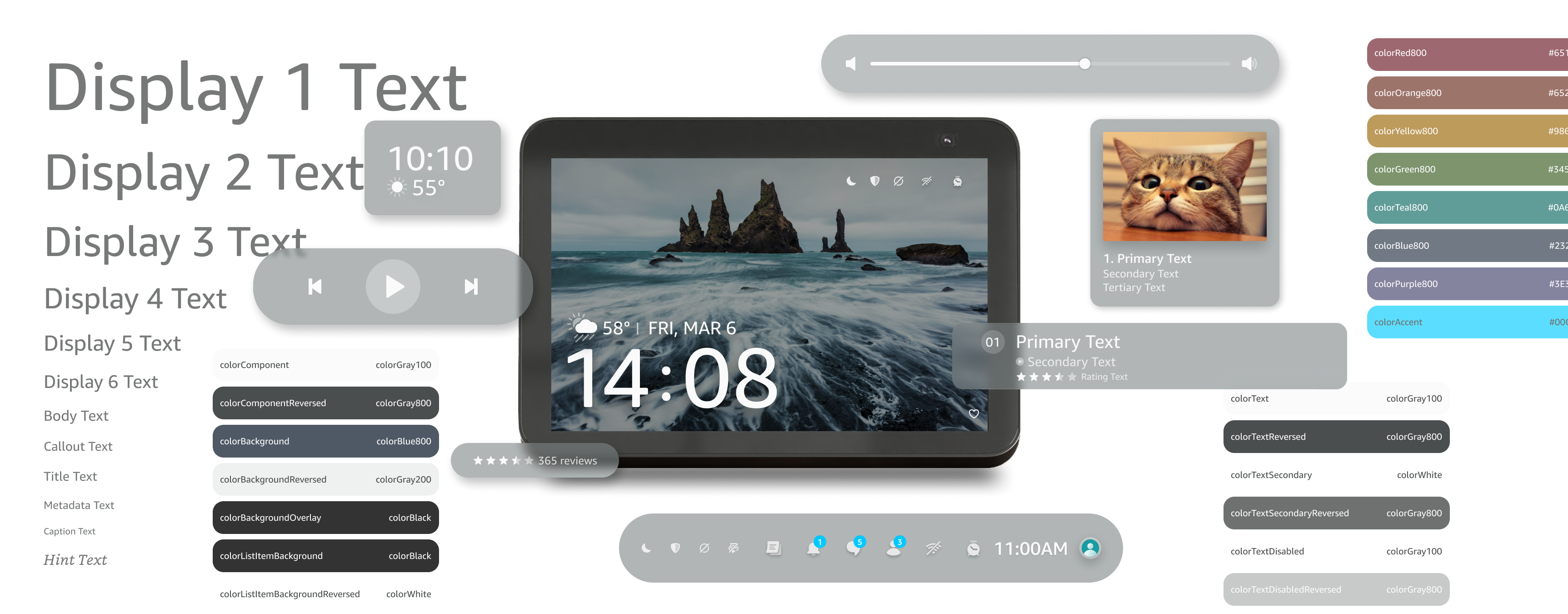
The Alexa Design System powers a growing ecosystem of multimodal experiences across the Echo Show family.
Since 2018, the system has evolved with new devices, capabilities, and tech stacks. The challenge was not simply maintaining consistency, but ensuring the system can continuously accommodate new requirements without becoming increasingly complex to use, implement, or maintain.
I collaborate with diverse design and engineering teams to explore requirements, and my expertise lies in bridging the gap between design and engineering.
I help teams identify reusable abstractions behind product requirements, align design decisions with implementation constraints, and evolve system foundations that remain scalable and accessible across devices, technologies, and future use cases.
Challenges & Solutions
01 /
Identifying What Should Become Part of the System
Not every feature deserves a new pattern, and not every custom solution should remain custom.
Working with multiple product teams gave me visibility into recurring problems that seemed unique at first glance but shared the same underlying solution. Rather than allowing teams to reinvent similar but slightly different solutions, I help identify opportunities for standardization and transform proven patterns into reusable system foundations.
At the same time, I believe a healthy design system should function as a two-way platform. While the system provides guidance and consistency, it must also evolve by learning from successful design solutions emerging from product teams. I work closely with partner teams via office hours and working sessions to formalize custom solutions and bring them back to the core system.
02 /
Scaling Across Devices and Modalities
Supporting new devices always presents an exciting challenge. For example, from expansive screens and remote-forward devices like Fire TV, to smaller phone-sized and voice-forward displays like Echo Show 5, and to even more compact and rounded devices like Echo Spot, the wide range of devices with differing shapes, sizes, resolutions, and modalities offers both opportunities and challenges.
As the Alexa ecosystem expanded, supporting new devices could not rely on creating separate design solutions for every screen size or modality.
To approach this challenge holistically, I worked with teams to identify scalable adaptation strategies, including responsive breakpoints, viewport profiles, density, scaling logics, and layout behaviors that could be shared across products.
We carefully integrated those guidelines and guardrails into the design system, paving the way for supporting future design and development.
03 /
Aligning Design Systems with Engineering Reality
I believe a design system only succeeds when it can be implemented consistently across different technologies.
As Alexa expanded beyond Android into web-based and Linux-based environments, I partnered closely with engineering teams to ensure system foundations remained technically feasible, accessible, and maintainable across platforms.
For example, from a general designer’s perspective, a screen consists of layers and groups with distinct styles. But from my engineering lens, creating that screen involves integrating various technologies to overcome technical challenges and limitations.
With experience in front-end development, I translated design intent into implementation-ready specifications across various programming languages. I also optimized assets for diverse technology stacks and developed compatibility strategies to support legacy devices.
04 /
Beyond Component: Maintaining System at Scale
After years of growth and maintenance, our token library exposed inconsistencies caused by Figma’s token infrastructure limitations. For example, when using the token library, designers encountered outdated values, stale references, broken token linking, and unreliable token behavior.
To restore confidence in the system, I migrated our latest token values to a clean foundation. However, the bigger challenge was to relink token references across hundreds of components efficiently.
It would be time-consuming and error-prone to swap out tokens manually, so I developed an internal automation plugin to map and replace token references at scale.
Reflection
Over the past 9 years, the Alexa Design System has evolved from supporting a single device to enabling experiences across more than ten devices, multiple interaction models, and several engineering platforms.
This work reinforced a belief that guides my approach today: as a design system designer, my goal is not to create more components, but to identify the right abstractions to build a scalable system that allows products, teams, and technologies to evolve together.
For a detailed case study walk-through, please reach out.