Context & Role
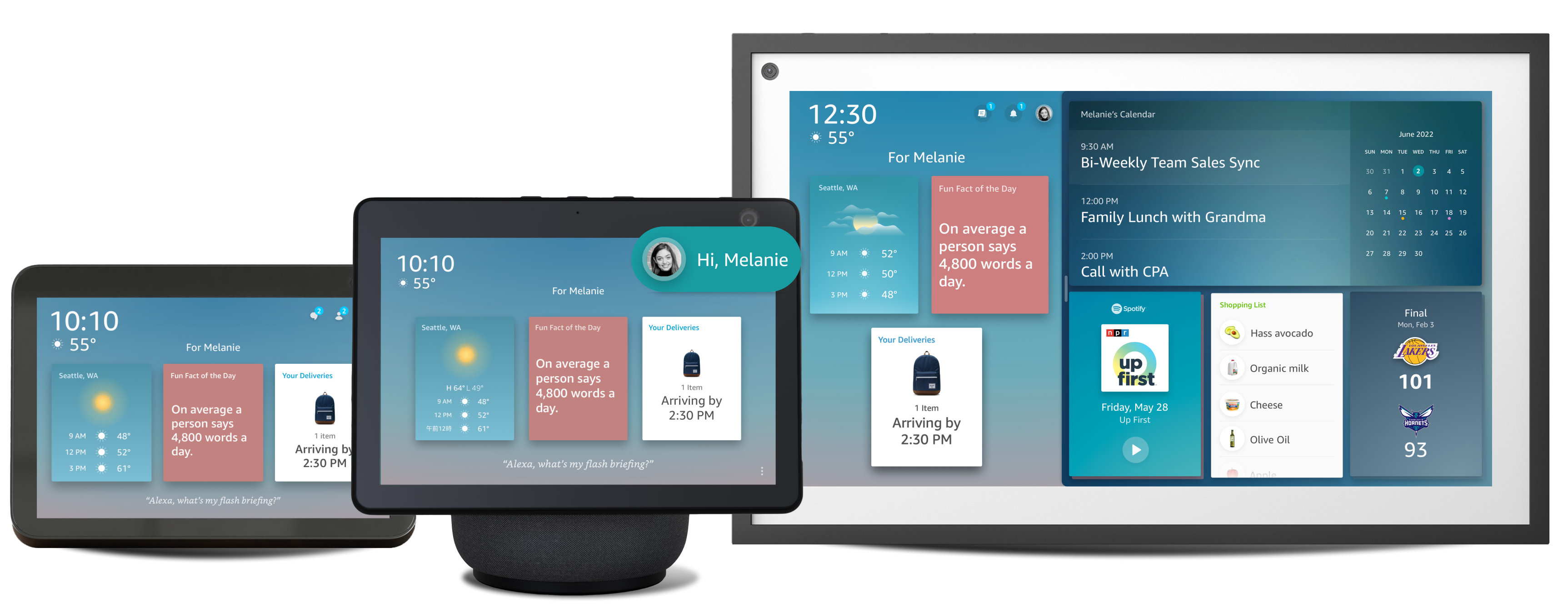
Visual ID empowers Alexa to deliver personalized, delightful experiences in shared spaces such as the family living room or kitchen. Once enrolled in Visual ID, customers can automatically receive personalized content at a glance, simply by showing up in front of their devices.
The challenge wasn’t simply recognizing who was in front of the device, but creating a flexible framework that could personalize content, adapt to different scenarios, and scale across the Echo Show device family without introducing fragmented implementations.
I led the design system and defined scaling patterns across Visual ID enrollment, profile greetings, and personalized summary cards.
This effort brought a successful feature launch in 2021 across Echo Show 8, Echo Show 10, and Echo Show 15.
Challenges & Solutions
01 / Visualizing Dynamic Facial Recognition
This dynamic feature requires the Echo Show’s home experience to pay extra attention to motion, and I took the lead to build this animated avatar greeting as a robust pattern.
I defined the structure of this animated component, built it as a reusable building block in the design library, created detailed engineering specs that ensured technical feasibility, and standardized theming, scaling, and edge cases’ handling logic.
02 / Abstracting the Shared Structure Behind Diverse Content
Visual ID brings a wide range of personalized content, such as reminders, calendars, notes, fun facts, shopping status, and much more.
The obvious solution would have been to design separate layouts for every content type. Instead, I looked for the underlying structure shared by those domains.
By abstracting common behaviors into a composable framework, I transformed a growing collection of custom designs into a reusable system that could accommodate future content with minimal additional work.
This approach reduced duplication, simplified implementation, and made future iteration significantly easier.
03 / Supporting Responsive Layout
Visual ID not only lives on 3 devices with different screen sizes, but also has to support a responsive layout on the largest Echo Show 15.
Rather than manually adapting every layout, I work with the team to define responsive behaviors and scalable structures that allow the same underlying pattern to adapt naturally to different screen sizes and content densities.
The result was a solution that scales well with both hardware evolution and future product requirements
Reflection
Visual ID reinforced an approach that has guided much of my work in design systems:
Rather than creating more custom components, I focus on identifying the abstractions. By aligning product requirements with implementation constraints, reusable structures can support not only today’s experience but also accommodate future product needs.
For a detailed case study walkthrough, please reach out.